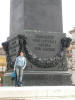
Oblisk in Munich
Impressionist Art Museum
Memorial to Anti-Nazi protestors
Battle scars
Glockenspiel
Glockenspiel
A bedding store?
Vitz Beer at the Hofbrauhous
Hofbrauhous exterior
Wahooo!
Inside the Old Town Hall
Its in German- don't bother :)
The site of past conflict
Plaque to the Bavarian officers who were killed in that confrontation
Paulaner Beer Hall
A private breweries celler
Down the hatch
Vitz beer, lager and ale.
Crazy americans girls that were on our tour
Caesar our tour guide and myself
Hofbrauhous at the end of the night
Struggle Town
Hangover number one
DACHAU CONCENTRATION CAMP
View from the inside
Main square
Watchtower
How they were kept in.
The perimetre
Evidence that this was true
Inside the bunker
The Barracks
The Barracks
The Barracks
Photo of a photo
Where the barracks used to stand
An airial photo of the hundreds of barracks at Dachau
Head count
Building X
The Bath House
Inside the bathhouse
Outside Building X and the gas chamber
The first crematorium.
One of the ovens in the second crematorium
Another oven in the second crematorium
Another photo of a photo
It speaks for itself
I loved this monument- it gave off good vibes
Catholic Memorial
An International Memorial to what occured at Dachau and other Nazi concentration camps
Out the gate- an experience I will never forget
When in germany....
This was on our first day. We set out with a map to explore the city and discovered that when we found things we had no idea what anything said. Good thing we already had guided tours booked
This building was actually errected during Hitler's reign. He had it built to hold Nazi art. Not as in art done by Nazi's but as in art that they approved of and permitted. Today as a silent 'up yours' to Hilter and his followers it holds impressionist paintings and sculptor- something the Nazi's strongly disliked.
For some reason there are only 2 monuments in Munich that can be viewed by the public to recognised the actions of people that lost their lives fighting against the Nazi movement. This particular one was errected to commemorate the death of four young Germans. They were arrested, trialed and murdered in less than 72hours by Nazi soldiers. It was obviously an unfair trial.
During World War 2 a whopping 70% of Munich was destroyed. This building which is now a government building is one of few that survived. If you look very closely at the pilars you may be able to see shrapnel damage
This is a very famous clock that stands in the Old Town on Marienplatz. At 12 o'clock everyday it comes to life and the little figurines inside move around as chimes sound.
Here you go mum, my head in a photo.
Not many people in Munich know this but, this building is the place the Nazi party used to meet and where they were based when Hitler joined them. Hitler was hired by the German military to join this party and spy on them, but was inspired by their ideas and joined them whole-heartedly.
Get that into ya! Germans don't muck around. Their beers are either a litre or a half litre. Not a middie in sight.
Yet again related to the Nazi party. There is a large function room above this very famous beer hall. Hitler and his party used to conduct meetings here.
Me outside the Hofbrauhous- the most famous beer hall in Germany and perhaps the world.
The symbols on the wall belong to Munich and its sister cities.
The inscription on the wall is to acknowledge and thank the American soldiers who over ran the Nazi's at the end of World War 2 and forced them to turn Munich over to the allies.
This is the exact site where Hitler and his followeres first came into conflict with the Barvarian police. Members of both groups died that day. One particular Nazi member sheltered Hitler when gunfire broke out and was later found with 7 bullet holes in his back.
There was a large monument that stood to commemorate the Nazi members that were killed in that same exchange but after the Nazi party fell from power, the government had it removed
The square in front of this structure (whose name escapes me) is where Nazi soldiers used to gather once a year to commemorate the loss of fellow members. The monument that no longer exists was up under this structure on the left, out of site in this picture.
This was stop one on our Beer Tour. Look at how sober I look here in comparison to the end of the night.
This beer hall was quite small and thus fresh beer is pumped straight up to the bar everyday.
Please note: Kristel is not a beer drinker and thus I consumed both her beers and my own. :) (as you would being an aussie)
In Germany beers must be brewed according to the Purity Rule which is a real law introduced many years ago. It states that beer can only be made from 3 essential ingredients and some people believe this stops you from getting a hangover. I can say pigs a*** to that one. :)
There is no photo of me and my dinner- Why? Because we all know, eatin is cheatin.
Yes, thats his real name.
We ended up at the Hofbrauhous, am I tanked or what?
There was a contiki group there that night, and they made me look sober! So bad.
We tried to calculate how much beer I drank that night. We ended up at around 7 litres. ow.
Oh, do you like our room?
Our tour to Dachau remains one of the highlights of my trip. The writing on the gate translates roughly to - Freedom through work, which is basically making a mockery of people held here.
The main gate and watchtower from the inside
This is the main square. Prisioners were made to gather here twice everyday for role call. They had to stand feet together, arms by their sides, head down. Sometimes for hours on end. Don't forget how cold it can get in Germany.
These towers were spread along the perimetre fence. SS soldiers manned these lookouts and were most definately armed.
First there is the outer wall, then an electric barbed wire fence, then a moat and then a strip of grass. 'A strip of grass?' I hear your say. Well, if any prisioner so much as put one toe on that grass they ran the risk of being shot by SS guards.
This building was known as the bunker. Special status prisioners were held in here but it was also where soldiers conducted various forms of torture.
They know that there were three major phases of overcrowding at Dachau. This is how the barracks (sleeping quarters) were originally designed. Note the shelves for each bunk and the devision of individual beds.
This was phase 2. No more shelves and more beds sqeezed into each room.
Phase 3. No more individual beds. Prisioners file in one by one and are made to lie on their sides, side-by-side to fit more men in.
This is the Barracks during phase one during the war.
The barracks that are still standing today (there are only 2)are exact replica's of the originals and are the only thing at Dachau that has been rebuilt.
This is a list of the number of people in each barrack. Soldiers used to do an approximate head count as prisioners were put to bed each night. At Dachau each barrack was designed to hold 600 men. The numbers here are a little above that.
Just outside the perimetre fence was Building X. It houses a wash room (gas chamber) and the second crematorium. (Or was that incinerator)
Select groups of prisioners were brought here after being told they were going for a wash. This would have been seen as a privilege to prisioners who lived in eachother filth day in and day out. However they were really being walked to their death. The Nazi's told prisioners this to keep them calm and avoid any resistance.
For many years it was thought that the gas chamber at Dachau was never used. However modern technology has proven that yes it was. Just not as often as the gas chambers at other concentration camps. In this photo I am reaching up to one of the shower heads. If you stick your finger under the fixture you quickly learn there is no plumbing for the shower. They were installed to further trick the prisioners.
These are the shoots were fatal tablets were inserted that would interact with the air, produce gas and eventually kill all those locked in the gas chamber.
Dachau was installed with one crematorium with four ovens. When overcrowding began the Nazi's could not burn the bodies fast enough so they errected more ovens to keep up with the carnage.
These ovens had a flute underneath them which allowed them to burn their contents faster.
I found the fact that the original stretcher is just sitting there, a little disturbing.
In this pic what you are seeing is a giant mount of dead bodies waiting to be burnt. If your dare, take a close look at the condition of the deceased bodies.
I cant remember the exact translation but Im pretty sure it was very close to- "To honour the dead and warn the living"
It is supposed to look like a grape presser. The lid is the Nazi soldiers and the 'grapes' inside are the prisioners
That was a mighty fine Schnitzel burger





 .
.

|

Oblisk in Munich
This was on our first day. We set out with a map to explore the city and discovered that when we found things we had no idea what anything said. Good thing we already had guided tours booked